
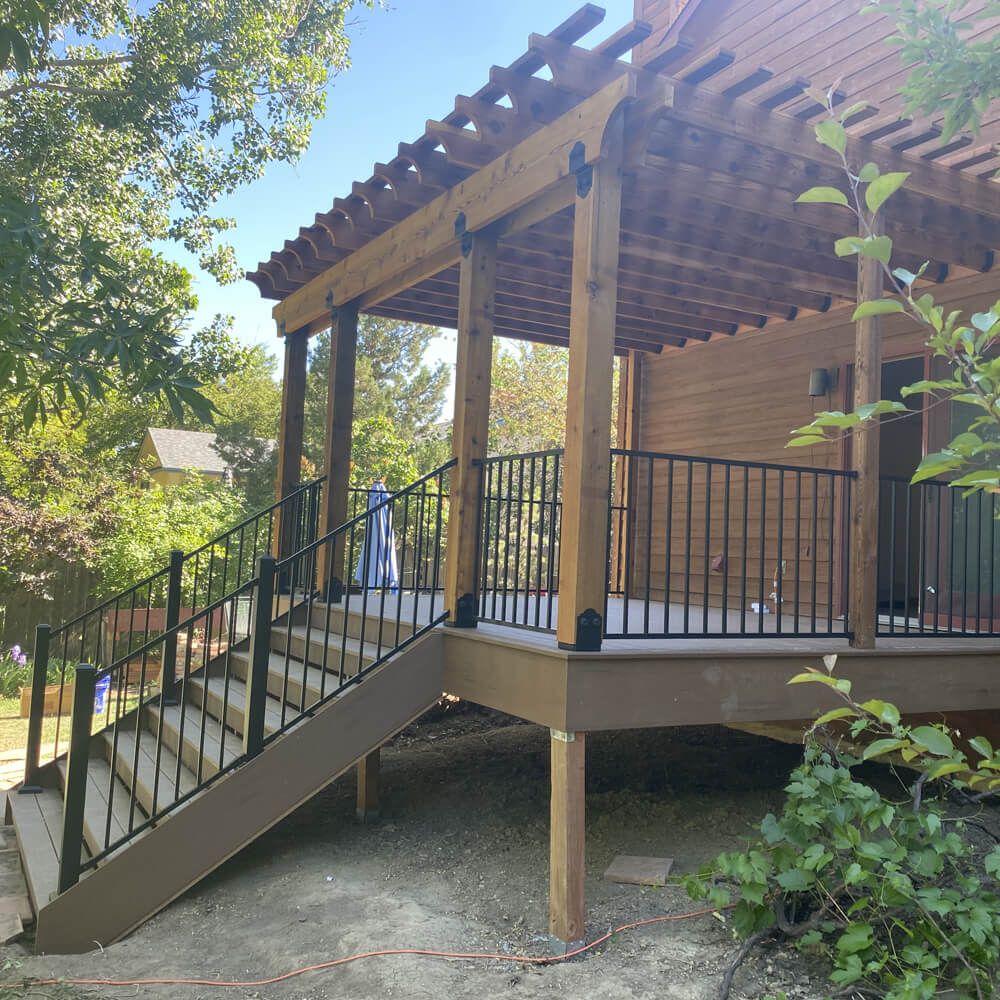
A step that rocks under your foot or a railing that gives a little when you lean on it is easy to live with for a season. It shouldn't be. Here's how to read wobbly deck stairs and a loose railing for what they are, with the real code numbers to measure against, so you know when it's a quick tighten and when it's time to repair or rebuild the stairs.
Quick Answer: When Wobbly Deck Stairs and Railings Need Repair
Repair is due when a step shifts underfoot, the wood feels soft or spongy, fasteners are rusting or backing out, or the railing moves when you lean on it. Then measure. The 2021 International Residential Code (IRC) caps stair risers at 7 3/4 inches, requires treads at least 10 inches deep, and, where a walking surface is more than 30 inches above the ground, calls for guards at least 36 inches tall with gaps too small for a 4-inch sphere to pass (34 inches and 4 3/8 inches on the open sides of stairs).
Signs Your Wobbly Deck Stairs Need More Than a Tightening
Most stair trouble shows up in the same few places. Walk the stairs slowly, top to bottom, and look for:
- Soft, spongy spots or dark, sunken areas in the wood. That's the warning sign for rot in the treads, the risers, or the stringers that hold them up.
- Steps that shift underfoot, or nails and screws you can hear rattling.
- Cracks or splits running along the boards.
- Rusty screws or nails, or heads pulling up out of the wood.
- Stairs that feel uneven from one step to the next.
Left alone, minor damage can turn into a bigger repair or a safety problem.
The Measurement Worth Checking
Looking at the boards is only half the check. The other half takes a tape measure. The code doesn't just cap how tall a step can be. It also limits how much the steps in one flight can differ from each other: under the IRC, the tallest riser can't beat the shortest by more than 3/8 inch, and the same 3/8-inch limit applies to tread depth. Larimer County's residential stairway handout repeats the core numbers, a maximum riser of 7.75 inches and treads at least 10 inches deep.
That's why one odd step matters even when every board looks fine. To check yours:
- Measure each riser vertically, from the leading edge of one tread to the leading edge of the next.
- Write the numbers down and compare the tallest to the shortest.
- Measure tread depth horizontally, front edge to front edge.
A spread of more than 3/8 inch, or any riser over 7 3/4 inches, is worth a professional look.
Signs Your Deck Railing Needs Attention
A railing has one job: keep someone from going over the edge. Here's what to check:
- It moves when you lean on it. Loose fasteners are one cause. Decay hidden where the posts meet the deck is another, and it's the one you can't see.
- It's too short. Where the walking surface is more than 30 inches above the ground, the IRC requires a guard at least 36 inches tall. On the open sides of stairs, the minimum is 34 inches.
- The gaps are too wide. Openings can't let a 4-inch sphere through, or a 4 3/8-inch sphere on the open side of stairs. A 4-inch ball makes an easy test.
- The stair handrail is missing or at the wrong height. Stairs with four or more risers need a handrail on at least one side, 34 to 38 inches above the tread nosing.
Strength counts too. The IRC's live load table lists a 200-pound concentrated load for guards and for handrails, applied at any point along the top. You can't test that at home, but a railing that already moves under a casual lean is reason enough to have it checked. Country Construction works on loose and worn deck railings, from tightening loose balusters to full replacements.
What You Can Fix Yourself, and When to Call Someone
Some of this is a Saturday job. Country Construction's own advice is that homeowners can usually handle:
- Re-tightening loose screws, baluster brackets, and post fasteners
- Spot-cleaning and restaining small sections after minor weathering
- Swapping out non-structural pickets
Call a pro when the problem is structural: rotted posts, cracked ledger connections, split beams, or decay you can't reach at the post-to-deck joints. Same for anything above ground level where a fall is a real risk. Soft or rotted stringers on the stairs belong in this group too, because fixing them means taking the damaged stringers, treads, and risers apart and checking for moisture and decay before anything new goes in.
Do Deck Stair and Railing Repairs Need a Permit?
It depends on where you live. Larimer County's deck handout says a building permit is required if the deck is more than 30 inches above grade or serves as the main entry or exit to the house. If neither is true, no permit is required. The handout is written about decks in general and doesn't spell out repairs, so call before you start. If you live inside a city or town, ask that building department too.
Either way, Country Construction's written estimates include guidance on permit needs and code considerations, and the team coordinates inspection steps as needed.
What a Stair or Railing Repair Looks Like
Country Construction has served Northern Colorado since 2007, and owner James Westers has been recognized as a Gold Star Installer for Lowe's of Fort Collins for multiple years. Here's how a stair repair usually goes:
- You share photos or details so the team understands what you're dealing with.
- An on-site safety assessment checks for movement, decay, and fastening problems, and reviews handrails, guardrails, and fasteners against common local code requirements.
- You get a written scope and estimate, with repair options ranked so you can choose what matters most.
- You approve the plan before any work starts.
The fix can be as small as a few worn treads or as big as rebuilding the whole run. If the boards or frame look tired too, mention it. The company also handles deck repair in Northern Colorado, from surface fixes to structural reinforcement.
Wobbly Deck Stairs and Railings: Common Questions
How tall does a deck railing have to be?
Under the 2021 IRC, guards must be at least 36 inches tall wherever the walking surface is more than 30 inches above the ground. On the open sides of stairs, the minimum is 34 inches. Larimer County's handouts list the same 36-inch and 30-inch figures.
How far apart can deck balusters be?
Close enough that a 4-inch sphere can't pass, including the gap between the bottom rail and the deck. On the open side of stairs the limit is a 4 3/8-inch sphere, and the triangle formed by a tread, riser, and bottom rail can't pass a 6-inch sphere.
What's the maximum step height on deck stairs?
7 3/4 inches per riser, with treads at least 10 inches deep. Larimer County's deck handout asks for an 11-inch run if the treads have no nosing. In that same handout, variation in rise or run over the entire stairs can't exceed 3/8 inch.
Can I fix a wobbly railing myself?
Often, yes, if it's loose screws, baluster brackets, or post fasteners. If tightening doesn't firm it up, or you find rot in a post or a cracked ledger connection, have it looked at.
Getting Wobbly Deck Stairs and Railings Fixed in Northern Colorado
A wobble won't fix itself. Walk your stairs, lean on the railing, and bring a tape measure and a 4-inch ball. If something fails, you can request a free estimate, and you'll approve the plan before any work begins.